The Bizarre Alien Flesh Monster Washed Up On A Public Beach That Is Terrifying Global Experts
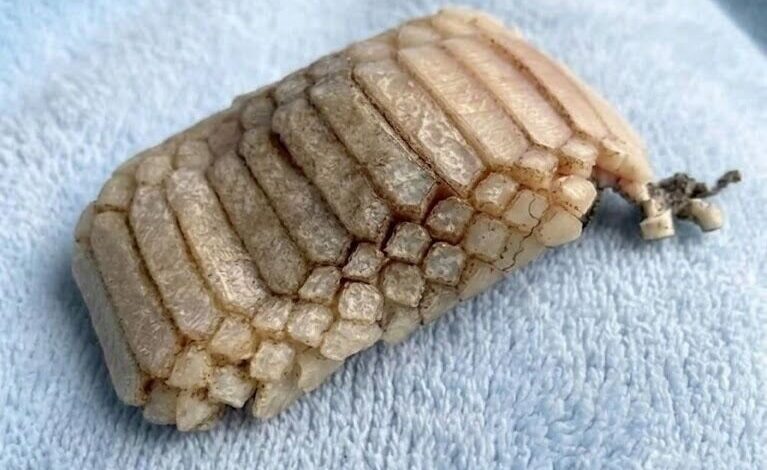
It all started with a single, incredibly detailed snapshot that was posted to a regular social media group. In a matter of hours, the image utterly upended the internet, leaving millions of people both completely enthralled and petrified with terror. The image showed a fat, hideous specimen that had silently washed up on a well-known public beach. Upon initial observation, the thing seemed to defy any rational categorization within the confines of terrestrial biology. Its asymmetrical shape and extremely rough, leathery texture made it appear remarkably fake.
The mass’s structural arrangement was the most concerning feature of the widely shared picture. The upper part seemed to be made up of inflexible, overlapping sections that resembled a row of sharp, petrified teeth. Some spectators claimed the entire mass resembled mechanical parts melded together with raw, rotting animal flesh, while other sections had pointed, skeletal protrusions that eerily resembled predatory claws. Although no two internet users could agree on the precise nature of what was lying in the sand, a global consensus quickly emerged that this entity was completely abnormal.
Online forums erupted into a tidal wave of dread and wild speculation as the enigmatic photo spread like wildfire over international news feeds. As worried citizens and armchair scientists attempted to figure out the origin of the seashore invader, dark theories quickly gained traction. A sizable portion of internet users were adamant that the creature was a highly developed deep-sea mutant, a previously undiscovered apex predator that had emerged from the deepest, darkest, high-pressure trenches of the ocean floor.
The object was unmistakable evidence of an unidentified extraterrestrial species that had mysteriously perished in the sea, according to another widely accepted and horrifying idea. The most extreme sections of the internet even whispered that the hideous mass was an engineered biological weapon that had unintentionally escaped containment and drifted down the shoreline, the disastrous result of a top-secret government cloning experiment gone catastrophically wrong. People’s casual curiosity turned into a full-fledged cultural obsession as they continued to focus on the image’s minute characteristics.
The creature’s strange, multi-layered anatomy kept stoking the digital panic. Screenshots that were zoomed in showed clear ridges that resembled rows of sharp, human-like teeth arranged in a tight, repetitive, and incredibly strange pattern. The creature appeared to be purposefully built or mechanically strengthened, according to observers who noted that its structural integrity did not match the typical organic fluidity of typical sea fauna. Because of this particular detail, the story gained significant attention and raised questions about what other horrific truths might be hiding beneath the world’s oceans, undiscovered.
However, competent marine biologists and international wildlife specialists came forward to analyze the contentious photograph through a scientific lens just as public fear reached an all-time high. The terrible worldwide enigma started to fully disintegrate after minutes of investigation, revealing the enormous discrepancy between biological fact and internet sensationalism. It was not a monster at all, despite the fact that it had caused widespread fear, alien conspiracy ideas, and accusations of genetic mutations. It wasn’t a biological weapon, a deep sea anomaly, or a clandestine experiment. Rather, the terrifying thing was actually the perfectly innocuous underside of a regular, everyday chiton.
A chiton is a fully harmless kind of marine mollusk that inhabits rocky shorelines all over the world and leads a peaceful, uneventful life. The animal seems completely ordinary when viewed from its regular, top-facing perspective; it resembles a small, flat, oval shell and blends in so well with the surrounding stones that most beachgoers pass them by without ever noticing. Eight interlocking, hard plates that serve as a natural coat of armor shield the top of the creature’s body, enabling it to cross tough, rocky terrain without getting hurt and endure the crushing weight of violent ocean waves.
The mere act of turning the creature upside down was the sole source of the severe worldwide terror. A chiton’s anatomy completely changes when it is removed from its rock and turned upside down, revealing its exposed underside to the camera. The snail uses a complex network of tight grasping mechanisms to anchor itself to slick surfaces, yet instead of a smooth, predictable shell, the observer is presented with a gigantic, very muscular foot. These interior gripping components create complex, geometric patterns that resemble rows of razor-sharp teeth or the metallic gears of a sophisticated machine when they are dried up and exposed to the open air on a sandy beach. This natural survival design appears startlingly strange to an inexperienced eye unfamiliar with the intricate details of marine life, conjuring images from a high-budget science fiction horror film.
The chiton is one of the world’s most amazing examples of natural engineering because, beneath the scary visual deception, it possesses a real, astounding biological superpower. The rows of ridges that were mistaken for enormous teeth are actually a portion of a radula, a specialized feeding device. Nature has strengthened the tips of these tiny teeth with a rare mineral called magnetite to enable the chiton to effectively scrape nutrient-rich algae off of solid rock walls in hostile, wave-battered settings. The chiton’s feeding structures are among the strongest and hardest biological materials ever found in scientific history because to the presence of magnetite, a naturally occurring, highly magnetic iron oxide. In reality, the same critter that caused global fear on social media platforms is a little evolutionary engineering powerhouse.
A fundamental and intriguing lesson about human psychology and our interactions with nature may be learned from this enormously popular occurrence. It unequivocally demonstrates that the great majority of human anxiety is caused by a complete lack of knowledge rather than real, physical threat. The human mind naturally rushes to fill in the information gaps with the most dramatic, worst-case explanations when it is suddenly presented with a highly novel visual input, especially when viewed from an unusual or distorted angle. Instead than posing a threat to humanity, the odd, squishy creature on the shore served as a lovely reminder that nature is full of tiny, hidden features that are always ready to surprise us if we only choose to look more closely with knowledge rather than fear.