Pope Shares a Single-Word Message to the United States — And the World Is Still Talking About It
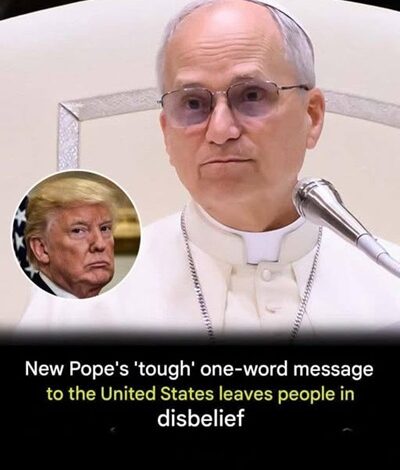
On May 12, 2025, the sun rose over Vatican City with an unusual sense of anticipation. Journalists from around the world gathered inside the Apostolic Palace for the first international press conference of Pope Leo XIV, the newly elected pontiff. The atmosphere was formal but electric, charged with curiosity about the tone his papacy would take.
Born Robert Francis Prevost in Chicago, Pope Leo XIV stepped into the room with calm composure. At 63 years old, he carried decades of pastoral experience and administrative leadership within the Church. Observers described him as thoughtful, steady, and deeply reflective — a man known more for careful words than dramatic declarations.
During the conference, a journalist asked a direct question: Did he have a message for the United States?
There was a brief pause.
Then, in a soft and measured voice, he replied with a single word:
“Many.”
Nothing more.
No explanation. No elaboration. Just one word — and silence.
Yet that silence seemed louder than a speech.
The Weight of Brevity
In a media era dominated by soundbites, outrage, and viral headlines, the simplicity of “Many” stood out. It was not confrontational. It was not flattering. It was not dismissive. It was open — and that openness created space for interpretation.
Within hours, analysts, theologians, and commentators began debating its meaning. Was it a critique? A reminder? An invitation? A reflection?
Those familiar with Pope Leo XIV’s history recognized the pattern immediately. Throughout his career, he has favored reflection over reaction, nuance over absolutes.
“Many” was not meant to accuse. It was meant to prompt thought.
A Word That Reflects Complexity
To understand the depth of that moment, one must consider the Pope’s background. Before his election, Cardinal Prevost had built a reputation for addressing social and moral questions with balance and compassion.
He frequently spoke about human dignity, economic justice, migration, and the responsibility of leadership. Rather than framing issues in partisan language, he focused on conscience and shared humanity.
Seen through that lens, “Many” carries layers of meaning.
Many challenges facing society.
Many responsibilities resting on leaders.
Many struggles experienced by families.
Many opportunities for compassion.
Many divisions — and many possibilities for unity.
It is a word that resists simplification.
Not Condemnation — But Conscience
Importantly, the Pope did not raise his voice or emphasize the word with dramatic tone. He delivered it calmly, almost gently.
That restraint was part of the message.
Unlike leaders who use spectacle to command attention, Pope Leo XIV appears committed to moral presence rather than performance. His approach suggests that leadership can be powerful without being loud.
By saying “Many,” he avoided narrowing the conversation to a single issue. Instead, he expanded it. He acknowledged that no nation can be reduced to one narrative — positive or negative.
In that sense, the word functioned as a mirror rather than a verdict.
A Papacy of Bridge-Building
Pope Leo XIV’s early speeches emphasize unity, peace, and responsibility shared across borders. He has spoken about the Church as a bridge — connecting communities rather than dividing them.
The choice of his papal name reflects that intention. Pope Leo XIII, whom he references symbolically, was known for advocating workers’ rights and social justice during times of industrial upheaval. That historical echo suggests continuity: faith must engage real-world concerns with humility and courage.
“Many” aligns with that vision. It acknowledges complexity. It invites introspection. It resists easy answers.
Why the Word Resonates
The enduring power of this moment lies in what it demands from the listener.
It asks individuals to examine their own role in shaping society.
It asks leaders to consider the weight of their influence.
It asks communities to recognize that national identity includes many voices, many experiences, many needs.
In a polarized world, the refusal to reduce reality to slogans feels almost radical.
Rather than telling the United States what to think, the Pope trusted its citizens to reflect.
Simplicity as Strength
There is a paradox in modern communication: the shorter the message, the harder it can hit. One carefully chosen word can carry more emotional and moral gravity than paragraphs of explanation.
“Many” does not close a conversation — it opens one.
It suggests that answers are not singular, and that understanding requires attention to multiple layers of truth.
That subtlety is perhaps why the moment continues to circulate across platforms, shared and discussed long after the press conference ended.
The Echo of a Single Word
What remains remarkable is not the drama of the exchange, but its quiet authority.
The Pope did not lecture. He did not criticize directly. He did not praise unconditionally.
He paused.
He spoke one word.
And he allowed it to breathe.
In doing so, Pope Leo XIV signaled that his papacy may be defined less by spectacle and more by reflection — less by confrontation and more by conscience.
Sometimes, leadership does not roar.
Sometimes, it whispers.
And sometimes, one word is enough.