Why Sarah Spain Says She Felt Uncomfortable Sitting Near JD Vance at the Winter Olympics
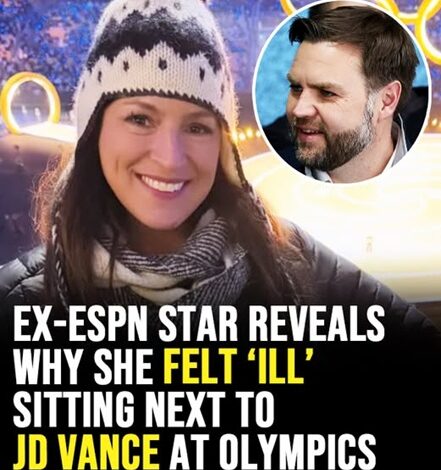
Former ESPN host and respected sports journalist Sarah Spain recently shared an experience from the 2026 Winter Olympics that left her unsettled — both personally and professionally.
While attending a women’s hockey matchup featuring Team USA, Spain found herself seated just a short distance from Vice President JD Vance and Secretary of State Marco Rubio. What began as a normal sporting event quickly turned into something far more disruptive than she anticipated.
On her podcast Good Game with Sarah Spain, she described the moment when security personnel suddenly flooded her section of the arena.
The Setting: Politics Meets the Olympics
The 2026 Winter Olympics in San Siro, Italy, brought together athletes from around the world, along with global leaders attending ceremonies and supporting their national teams.
Vice President JD Vance and his wife, Usha Vance, were among the American dignitaries present. As is standard for high-ranking officials, they were accompanied by Secret Service agents.
While the presence of political leaders at international sporting events is common, Spain said the security response dramatically changed the atmosphere around her.
“A Wall” of Security
Spain recalled that roughly twelve minutes into the first period, her view of the ice was suddenly obstructed.
Large security personnel filled the area, forming what she described as a physical barrier between her and the game.
As a journalist attending to observe and analyze the match, the obstruction created frustration. Spain emphasized that her primary purpose was to watch and report on the hockey game — not navigate the logistics of political security.
The U.S. women’s team would go on to win decisively, but Spain said her ability to fully experience the game was compromised.
A Visceral Reaction
Beyond the logistical disruption, Spain described a strong emotional reaction to sitting near the vice president.
In colorful language on her podcast, she said she felt physically uneasy, comparing the sensation to something almost surreal or instinctive.
Her comments quickly drew attention online, not only because of the imagery she used but because of what they suggested about the intersection of politics and personal reaction.
Spain clarified that her discomfort wasn’t just political disagreement — it was a physical, instinctive response she did not expect.
Mixed Reactions at the Opening Ceremony
The political undertones had already been visible during the Olympic opening ceremony.
Television coverage showed a mix of applause and audible boos when JD Vance appeared on screen. International sporting events often draw emotionally varied reactions toward political figures, especially when global audiences are involved.
Such reactions underscore how politics can follow leaders even into traditionally celebratory spaces.
Support for Team USA
Despite the mixed public reception, Vance actively engaged with Team USA athletes during the games.
He offered words of encouragement, emphasizing national unity and pride regardless of political affiliation.
Statements like these are common during international competitions, where leaders often attempt to project bipartisan support for athletes representing the country.
The Broader Issue: Sports and Political Presence
Spain’s experience has reignited discussion about the broader intersection of sports, politics, and media access.
High-profile political attendance often requires strict security measures, which can alter seating arrangements, visibility, and general event flow.
For journalists, whose job depends on clear sightlines and immersion in the event, such disruptions can complicate coverage.
For fans, the presence of security details may also change the atmosphere of what is meant to be a shared, celebratory space.
Journalism in Politically Charged Spaces
Sarah Spain has built a reputation for candid commentary on sports and culture. Her reflections from the Olympics continue that pattern — blending personal reaction with analysis of larger themes.
Her comments sparked debate online, with some defending her frustration over obstructed views, while others focused on her metaphorical language describing her reaction.
Regardless of political affiliation, her experience highlights a reality often unseen by television viewers: live events involving political leaders come with operational challenges.
The Ongoing Conversation
The episode has opened a broader dialogue about how much influence political presence should have at sporting events.
Should VIP attendance be prioritized even if it disrupts journalists and fans?
How can event organizers balance national representation, security needs, and spectator experience?
These are questions likely to surface again as sports and politics continue to intersect on global stages.
Conclusion
Sarah Spain’s account from the Winter Olympics serves as more than a personal anecdote.
It reflects the tension that can arise when politics enters spaces traditionally reserved for athletic celebration.
While political leaders play ceremonial roles at international competitions, their presence can reshape the experience for those seated nearby.
Spain’s candid storytelling brings attention to that intersection — reminding audiences that sports, politics, and media are often more intertwined than they appear.