My Daughter Banned Me From Thanksgiving to Make Room for Her Mother-in-Law — So I Took Back My Table and Found a New Family
“Mom, I think it might be best if you stayed home on Thursday.”
Those words left me frozen in my kitchen on the Sunday evening before Thanksgiving. In front of me sat a basket of bread I was tearing into pieces for the dressing, just as I had done for more than forty years.
My daughter, Stephanie, explained that her new mother-in-law, Arlene Lindquist, was hosting relatives from Holdrege, while other family members were traveling from Lincoln, Nebraska.
There would be twelve people around the table, she said, and they needed enough room for everyone.
What Stephanie conveniently forgot was that the nearly ten-foot oak dining table, its two extension leaves, and all twelve chairs belonged to me.
I’d lent them to her in June, after she married Curt and moved into a house with an empty dining room.
My late husband, Don, and I had bought that table for just $85 at a farm auction in 1981. He’d spent an entire spring stripping away its ugly green paint to reveal the beautiful oak underneath.
Now, at 66, I was being told there wasn’t room for me at the Thanksgiving celebration I’d helped make meaningful for decades.
I could have argued. I could have reminded Stephanie that the turkey in her garage refrigerator was mine. I could have demanded that she change her mind.
Instead, I wished her a pleasant Thanksgiving and ended the call.
I wasn’t going to beg for a seat at a table I’d spent years filling with love.
That evening, I thought about Harold, a widower from my Methodist church whose wife had died in March after 51 years of marriage. He’d told me he planned to spend Thanksgiving alone at a highway café.
Suddenly, I knew what I wanted to do.
I called Harold and invited him to share the 22-pound turkey I’d already purchased.
Then I asked my neighbors, Wayne and Donna, to help me bring my dining furniture home.
Word spread quickly. Before long, other people facing a lonely holiday began asking whether they could join us.
By Monday morning, my Thanksgiving plans were taking shape.
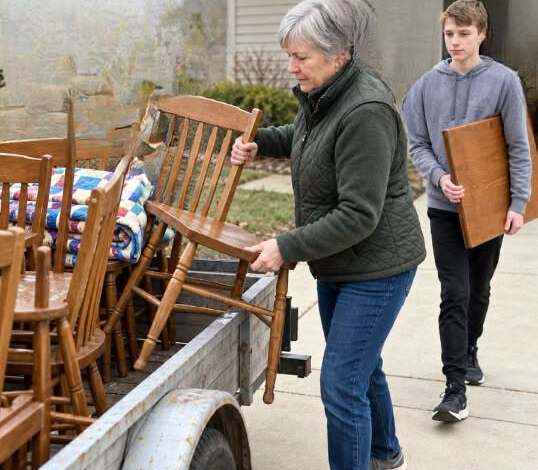
On Tuesday, I arrived at Stephanie’s house with Wayne’s pickup and stock trailer.
My grandson, Dylan, helped wrap the chairs and carry the heavy table outside. While moving the furniture, he discovered handwritten notes his grandfather had left beneath the seats.
One read:
“Dylan. Reglued 2019. So does he.”
Dylan rarely talked about losing Don, but seeing those words made him stop and stare.
He suddenly understood how much love his grandfather had put into maintaining something that had served our family for generations.
I took only what belonged to me: the oak table, its two extension leaves, the twelve chairs, and my turkey.
Before leaving, I told Stephanie that she, Curt, and every relative she’d invited would always be welcome in my home.
When she returned and discovered her dining room had been emptied, she finally began to understand that this was about much more than furniture.
On Thanksgiving Day, fourteen people gathered around my old oak table.
Harold came. Wayne and Donna joined us. Two young children arrived with their family, along with a college student who couldn’t travel because the roads were closed and a 91-year-old retired teacher.
We squeezed onto the chairs and a piano bench, passed dishes from one person to another, and laughed when Harold’s attempt at saying grace was interrupted by a little boy enthusiastically shouting, “Amen!”
The house was noisy, warm, and full of life.
For the first time in days, I wasn’t thinking about the daughter who had excluded me.
I was thinking about all the people who had nowhere else to go—and how grateful I was that my home could welcome them.
That afternoon reminded me that the true value of a home has nothing to do with its furniture, mortgage, or size.
But Stephanie’s Thanksgiving took an unexpected turn, too.
She had been forced to improvise with borrowed folding tables. When Arlene asked what had happened to the beautiful oak dining set, Stephanie finally confessed that she’d excluded me because she wanted to prove she could organize Thanksgiving independently.
Arlene was genuinely shocked.
She had never demanded my table or asked Stephanie to leave me out. She’d simply mentioned how much she missed the dining table she’d sold after leaving her farmhouse.
Stephanie had mistaken a nostalgic remark for a demand—and pushed her own mother aside because of it.
Later that evening, she arrived at my house with Curt and Arlene, carrying two untouched pies.
They apologized.
Stephanie admitted that she’d wanted to prove her independence and had made a terrible decision. I admitted something, too: sometimes I’d taken over her kitchen without giving her enough room to do things her own way.
We finally understood each other.
The oak table would stay with me, and I’d help Stephanie find a dining set of her own.
In December, Arlene discovered a round oak table at an estate sale for $160. Curt and Wayne transported it home using the same trailer they’d used to move mine.
Since then, Arlene and I have been searching for matching chairs. Stephanie has started preparing the gravy at my house, while I sit quietly on a stool and let her take charge.
Harold now joins us for Sunday dinners, and the people who once dreaded spending holidays alone have become familiar faces around our table.
I even tucked a little note beneath Arlene’s chair.
It read:
“Brought the pies.”
Sometimes, I smile when I think about how an inexpensive table bought at a farm auction became the center of so many memories.
My husband had restored it with his own hands. Our family had gathered around it through celebrations and grief. And one painful Thanksgiving taught us something none of us would ever forget.
Family isn’t about who gets the biggest seat at the table. It’s about making sure nobody who needs a place to belong is left standing outside.