“She’ll Still Pay for My Hair,” My Ex-Mother-in-Law Laughed on the Courthouse Steps. Four Days Later, Her Son’s Card Came Back at the Boat Show
My name is Angela, and for eleven years I paid for two people who never once said thank you.
I’ve worked the grill at Peg’s diner in Kittanning for twenty-two years. I can crack eggs two at a time and keep six orders straight in my head while the radio plays. Numbers come easy to me at work. It’s at home that I stopped counting.
Faron Mott was sweet once. When we were young, he’d wait in his truck after my late shift with a slice of coconut cream pie and one plastic fork. We’d split it with the heater running and the country station turned low. I married him for those nights.
In 2015, his body shop closed. His credit went with it, and so did his mother’s, because Earline had co-signed his last loan. “Just till I’m back on my feet, Ange,” he told me. So I added him to my credit cards as an authorized user. Then Earline. The accounts stayed in my name. The statements came to my mailbox. The payments came out of my paycheck and my tip jar.
The napkin I threw away
Gas. Beer. Bait. The casino bus to Erie. And every Friday at ten a.m., Earline’s wash and set at the salon on Market Street.
It came to about six hundred dollars a month. One slow afternoon I did the math on a diner napkin. Six hundred times twelve times eleven. Almost eighty thousand dollars.
I looked at that number for a long time. Then I tore the napkin into little pieces and dropped it in the fryer trash, because knowing it didn’t change anything. I still had to go home.
This spring, Faron packed a duffel bag and said he needed “to live a little.” He took the big TV. He left me the house payment. And I didn’t fight him on a single thing in the divorce, because I was scared that if I made noise, the judge would split his debts with me too.
The courthouse steps
Our divorce was final last Tuesday. I wore my good blue blouse. Faron wore a fishing shirt with a bass on the pocket. Earline came along with a fresh perm, the one I’d paid for the Friday before.
Outside, on the stone steps, she pulled her coat tight and laughed like she was at a bingo hall.
“Well, don’t you worry, Faron. She’ll still pay for my hair.”
Faron laughed too. “Ange doesn’t know how to say no. Never did.”
They didn’t even lower their voices. A lady walking past with a stroller glanced at me like she felt sorry for me. That look hurt worse than the words.
I smiled. “Of course,” I said.
Then I held out my hand and asked for the cards back.
Faron’s face went hard. “You start trouble over a couple of credit cards,” he said, “and I’ll tell Peg you’ve been skimming the register.”
I had never taken a penny from Peg in twenty-two years. But this is a small town. A rumor like that can follow you to the grocery store, to church, to every job application you’ll ever fill out. My stomach turned over.
Twenty minutes in a parked car
I drove straight to the diner and told Peg everything. She was flipping hash browns and didn’t even turn around.
“Angela, honey, if Faron Mott walks in here to talk about you, he’s paying for his coffee first. And then he’s leaving.”
On my lunch break, I sat in my car behind the dumpster and called the banks. First card: closed. Second card: closed. On the third one, the one I use for groceries, I just took their names off. My lawyer had told me the cards were mine to handle. They weren’t even mentioned in the divorce papers.
That night, I cut my own copies in half over the kitchen trash can. When the last piece fell, I sat down and shook like I’d done something criminal.
Wednesday, Faron texted: “Gas pump ate my card. Stupid machine.” I didn’t answer. Thursday, Earline called the diner. Peg told her I was busy, which was true.
Faron still had one card left in his wallet. He didn’t know it was dead too.
The red bass boat
Saturday was the county sports show at the fairgrounds. Peg’s diner runs a food stand there every year, and I work the pierogi pan. My mother’s recipe, potato and cheese, a dollar fifty apiece.
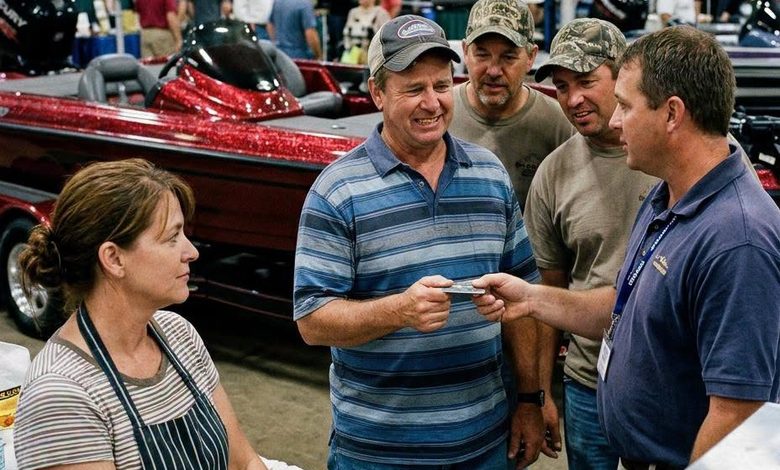
Around noon, I looked up and saw Faron walking into the boat tent with three of his buddies in camo caps. He stopped at a used bass boat, glitter red, and patted it like a horse.
“Fifteen hundred down holds it?” he said loud enough for half the tent. “Done. Run it.”
He pulled out his wallet slowly so the boys could watch. He handed over the card with his name on it. My card.
The salesman swiped it. Frowned. Swiped it again.
Then he looked at the little screen, looked at the back of the card, and started walking across the tent. Not toward Faron.
Toward me.
Why would a boat salesman I’d never met walk straight past my ex-husband and stop at my pierogi table with his card in his hand?
He was a big man in a Steelers jacket with a name tag that said DALE. He set the card down on my table next to the sour cream.
“Ma’am,” he said, “are you Angela Mott?”
I nodded. My spatula was still in my hand.
“The machine says the account is closed, and the bank wants me to call the primary cardholder. Your name’s the primary.” He turned the card over. “And this is your stand, right? Peg’s? My mother used to eat at that diner every Sunday.”
Behind him, the whole boat tent had gone quiet. Faron’s buddies were staring. Faron’s face was the same red as that boat.
“That account’s mine,” I said. My voice came out steadier than I expected. “I closed it Tuesday. He’s not authorized on anything of mine anymore.”
Dale nodded like that was the most ordinary thing in the world. Then he walked back to Faron and held out the card between two fingers.
“Sir, this card belongs to the lady at the pierogi stand. You got another way to pay the fifteen hundred?”
Faron opened his wallet again. There was a five and two ones inside. One of his buddies, a guy I recognized from the bowling alley, actually laughed out loud. “Mr. Moneybags,” he said, and this time it didn’t sound like a compliment.
“Tell Peg whatever you want”
Faron marched over to my table. He leaned in close so nobody would hear, the way he always did when he wanted me small.
“You embarrassed me in front of everybody. You know what I’m gonna tell Peg.”
Peg was standing right behind me with a tray of onions. She set it down.
“Go ahead, Faron,” she said. “Tell me. I’ll pull twenty-two years of register tapes, and then I’ll tell the whole county why you needed to make something up about the woman who paid your gas for eleven years.”
He didn’t say anything. For the first time since I’d known him, Faron Mott had nothing to say.
He left the fairgrounds without his buddies. They stayed and bought pierogi. Six each.
Friday, ten a.m.
The next Friday, Earline went to her hair appointment like always. The salon on Market Street had kept my card on file for years. It got declined.
Her stylist, Rhonda, called me at the diner to ask if there’d been a mistake. I told her there hadn’t. Rhonda was quiet for a second, then said, “Good for you, Angie. She never tipped anyway.”
Earline walked out of that salon with wet hair in a plastic cap. Half of Kittanning heard about it before lunch.
Two weeks later, she came into the diner. She sat at the counter, ordered coffee, and waited until the place was nearly empty.
“Faron’s sleeping on his cousin’s couch,” she said. “He can’t make his truck payment. I thought, since you two were married so long, you might help him out. Just this once.”
I wiped the counter in front of her. Then I cut a slice of coconut cream pie and set it down with one fork.
“That’s on the house, Earline,” I said. “The rest isn’t.”
She looked at the pie for a long time. Then she paid for her coffee with exact change and left.
What six hundred dollars a month looks like now
Without Faron and Earline on my cards, I had about six hundred extra dollars every month for the first time in eleven years.
The first month, I caught up on the house payment. The second month, I fixed the porch steps that had been rotting since 2019. The third month, I opened a savings account and named it “Napkin,” because that’s where my $80,000 went the first time, and I promised myself it wouldn’t happen again.
Dale from the boat tent comes in for breakfast now on Saturdays. Two eggs over easy, rye toast, and a side of pierogi. Last week he asked if I’d ever been fishing on the Allegheny. I told him I’d paid for a lot of fishing trips but never actually gone on one.
He laughed and said, “Well, I’ve got a boat that nobody bought. You bring the pie.”
I said yes. It turns out I do know how to say no. I just needed to learn when to say yes, too.
Have you ever carried someone who laughed at you for it? What made you finally put them down? Tell us in the comments.