At My Husband’s Funeral Lunch, His Brothers Slid Me a $500,000 Check and Said, “You Have Until Planting to Get Out” — So I Bought the 80 Acres Across the Road
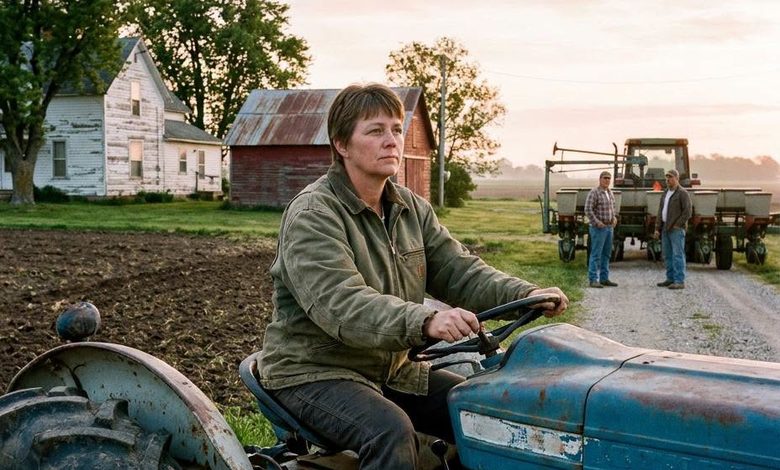
The funeral lunch was in the church basement. Ham sandwiches, three kinds of Jell-O salad, and folding chairs that squeaked every time someone sat down.
I was standing by the coffee urn when my husband’s older brother, Curtis, touched my elbow and asked if he and Dean could “have a word” in the hallway.
Curtis pulled a long white envelope out of his suit jacket. Inside was a cashier’s check for $500,000.
“That’s Wade’s share of the partnership,” he said. “It’s fair. More than fair. The house belongs to the operation, Carol, so we’ll need it back. You and Josie have until planting. Town will be easier for you anyway.”
Wade had been in the ground for about four hours.
Twenty-two years on that farm
My name is Carol Hensley. My husband, Wade, farmed wheat and milo with his two brothers on fourteen hundred acres in central Kansas. He was forty-nine when his heart stopped in the shop one evening while he was changing a belt on the combine. I found him there with a flashlight still on beside him.
For twenty-two years, I kept the books for the partnership. I paid the seed bills, did the payroll for the summer help, and drove the grain cart every harvest. I knew those numbers better than either brother.
I also knew the partnership agreement. If one brother died, the other two could buy out his third. The house sat on partnership ground. Legally, the offer was correct.
What wasn’t correct was doing it next to a table of deviled eggs, before the flowers on his grave had even wilted.
I didn’t argue. I folded the envelope into my purse, went back inside, and sat down next to my fourteen-year-old daughter, Josie, who was pushing a brownie around a paper plate.
The For Sale sign
That night, Josie asked me if we’d ever get to see Daddy’s fields again.
I stood at the kitchen sink and looked out the window. Across the gravel road was the old Ostrander place. Eighty acres of good ground, a little white house with a sagging porch, and a red barn with half its paint gone. A For Sale sign had been leaning at the end of the driveway since fall.
Wade had wanted that place for years. “Someday that’s Josie’s,” he’d say every time we drove past.
The asking price had dropped to $440,000.
I got a pencil and the back of a feed bill and started doing math. If I bought it outright, I’d have about $60,000 left for equipment, seed, fuel, and groceries until harvest. No cushion. No room for a bad year.
By sunrise I had made up my mind. I wasn’t moving to town.
Moving across the road
Monday morning, I deposited the check and made a full-price cash offer on the Ostrander place. The family accepted by noon. My lawyer confirmed the buyout released me from every partnership debt.
At a farm auction two counties over, I bought a tired old tractor for $29,000 and a used drill for $8,500. After seed and fertilizer, I was down to almost nothing. And I’d missed the crop insurance deadline. One hailstorm could wipe me out.
Then I found out why Curtis had wanted us out so fast. His son, Tyler, was graduating from K-State in May. Curtis planned to give him our house.
Josie and I moved across the road in the middle of April. On our last trip out of the old house, she found her dad’s sweat-stained feed cap on the hook behind the back door. She put it on. It came down over her eyebrows.
The first morning in the field
The first warm day of spring, I climbed onto that tractor and drove into my eighty acres.
Across the road, Curtis and Dean were hooking up their big planter. I saw them stop and watch me. Nobody waved.
It was a terrible day. The hydraulics leaked. The drill clogged twice. My back was on fire by noon. By sundown, I’d only covered eighteen acres. Josie rubbed Icy Hot into my shoulders that night, the way Wade used to do for me after harvest.
The next morning, before the sun was up, I was wrestling a seed bag onto the drill when I heard boots on the gravel behind me.
It was Tyler. Curtis’s boy. The one who was getting my house.
Down the road, his father stood beside a pickup with the headlights on, watching us.
Tyler stopped in front of my tractor, looked at the drill, then looked straight at me.
“Aunt Carol,” he said, “there’s something I have to tell you before my dad does.”
What could a twenty-two-year-old boy possibly need to confess at five in the morning, standing between my field and his father’s truck?
“I didn’t ask for your house,” Tyler said. His voice cracked. “I didn’t even know Dad gave you that check at the funeral until Josie told my sister. I would never have taken it. I feel sick about it.”
Then he nodded at the drill. “Uncle Wade taught me to run one of these when I was ten. Let me drive. You haul seed.”
He looked so much like Wade at that age that I couldn’t speak. I just handed him the keys.
We got more done by ten o’clock than I’d done the whole day before.
The seed tender
Around lunch, Dean pulled into my field with the partnership’s big seed tender. He filled my drill without a word, unhooked the tender, and left it sitting at the edge of my field.
“Keep it till you’re done,” he said.
When I thanked him, his eyes got wet. “I should have said something in that hallway, Carol. I just stood there. Wade would be ashamed of me.”
Sunday dinner
That weekend, Curtis’s wife, Brenda, called and asked Josie and me to Sunday dinner. At my old house.
We sat at the same oak table where Wade used to say grace. Before anyone ate, Curtis stood up.
He said the bank had been on him about the operating loan, and he’d panicked. But mostly, he admitted, he’d wanted to set Tyler up the way their dad never set him up. He’d told himself the buyout was a kindness. Watching me fight that old tractor alone for two days had made him see what he really did.
“You can have the house back,” he said. “I mean it.”
I told him no. I had a house. I had eighty acres in my own name. What I wanted was for Josie to still have her dad’s family.
Then Tyler went into the pantry and came back with a narrow strip of painted wood. He’d pried it carefully off the doorframe. It had fourteen years of Josie’s height marks on it, every one written in Wade’s blocky carpenter’s-pencil handwriting. The last one said “Jo — 14 — Christmas.”
Josie held that strip of wood against her chest and hugged Tyler so hard he nearly fell over.
Harvest on the Ostrander place
We finished planting a few days later. That evening, Josie and I stood at the end of my driveway and watched two sets of tractor lights moving through the dark. One on each side of the road.
We got rain in June and again in July. At harvest, my eighty acres made fifty-three bushels an acre. Not a record, but good for a widow who planted late on a borrowed seed tender.
Curtis brought over the family combine and cut it for me. I insisted on paying the custom rate. He insisted on not cashing the check. We’re still arguing about it.
With the grain money, I paid off the tractor and opened a savings account in Josie’s name with $5,000 in it. The land goes to her when she’s twenty-one, just like Wade wanted.
Tyler nailed that strip of wood inside my front door. On Josie’s fifteenth birthday, she stood against it in her socks, and I made a new mark with Wade’s old pencil. “Jo — 15 — Ostrander place.”
She says she’s driving the tractor next spring. I told her she needs to reach the clutch first. She stood on her tiptoes, grabbed her dad’s cap off the hook, and pulled it on. It still slips over her eyebrows. Just not quite as far.
They gave me $500,000 to disappear. I used it to stay where my daughter could see her father’s fields every single morning.
Would you have taken the house back when Curtis offered? Tell us what you think Carol should have done.