Donald Trump Says Families of Six Soldiers Killed in Iran Conflict Shared a Request With Him
The conflict involving the United States, Israel, and Iran has rapidly become one of the most serious geopolitical crises in recent years.
What began as a series of coordinated military operations has now developed into a broader regional confrontation that continues to draw global attention.
In late February 2026, the United States and Israel launched a large-scale military campaign targeting several strategic locations inside Iran. The operations were described by officials as precise strikes aimed at military infrastructure and command networks connected to Iran’s security apparatus.
During the opening phase of the campaign on February 28, Iranian state media and multiple international outlets reported that Iran’s Supreme Leader, Ayatollah Ali Khamenei, had been killed during the attacks. The announcement sent shockwaves throughout the Middle East and across the international community.
The reported death of the longtime Iranian leader marked a turning point in the conflict. Khamenei had served as Iran’s supreme authority for decades, shaping the country’s political, military, and ideological direction since the late twentieth century.
Following the strikes, Iranian officials declared a national mourning period and warned that retaliation against American and allied targets would follow. Tensions rose quickly as both sides prepared for possible escalation throughout the region.
In the days that followed, Iran launched missile and drone attacks aimed at several locations believed to host American or allied military personnel. Some of these strikes targeted facilities and bases across the Persian Gulf region.
Countries including Israel, Bahrain, Kuwait, Qatar, Jordan, and the United Arab Emirates were placed on heightened security alert as regional defense systems prepared for additional attacks. Governments throughout the region activated emergency coordination and protective measures.
Amid the growing tensions, one of the most tragic incidents occurred on March 1, 2026. On that morning, an Iranian one-way drone strike hit a tactical operations center located near Port Shuaiba in Kuwait.
The facility had been used as a backup operations hub supporting American military logistics connected to the wider campaign. Although the site was protected by reinforced barriers, the drone managed to evade air defenses and strike the structure directly.
Military officials later explained that the building targeted by the drone was a temporary tactical command center located near the larger Camp Arifjan base. The facility had recently been repurposed to reduce exposure to potential retaliatory attacks.
The impact of the strike caused severe damage to the building and resulted in the deaths of six United States Army service members who were stationed inside the operations center at the time of the attack.
The six soldiers who lost their lives were identified as Major Jeffrey R. O’Brien, Captain Cody A. Khork, Chief Warrant Officer 3 Robert M. Marzan, Sergeant First Class Nicole M. Amor, Sergeant First Class Noah L. Tietjens, and Sergeant Declan J. Coady.
These service members were assigned to a logistics support unit associated with the U.S. Army Reserve’s 103rd Sustainment Command. Their work involved coordinating supplies and operational support for forces deployed across the region.
Military leaders described the soldiers as experienced and dedicated professionals who had volunteered to serve their country during a period of escalating international tension.
The attack also left dozens of additional service members wounded. Several individuals suffered serious injuries including burns, shrapnel wounds, and traumatic brain injuries, according to reports from medical officials.
Many of the wounded personnel were transported to military hospitals in Germany, Washington, D.C., and Texas for advanced medical care. Some required urgent evacuation due to the severity of their injuries.
Despite the rapid medical response, the emotional impact of the incident was deeply felt within the United States military community and among the families of the fallen soldiers.
On March 7, the remains of the six service members were returned to the United States through a process known as a dignified transfer ceremony at Dover Air Force Base in Delaware.
A dignified transfer is a solemn military tradition honoring service members who died in combat or operational missions. During the ceremony, the flag-draped caskets of fallen personnel are carefully carried from the aircraft with full military honors.
Family members, military officials, and senior government leaders are often present to pay their respects. The ceremony is considered one of the most meaningful ways the United States honors those who gave their lives in service.
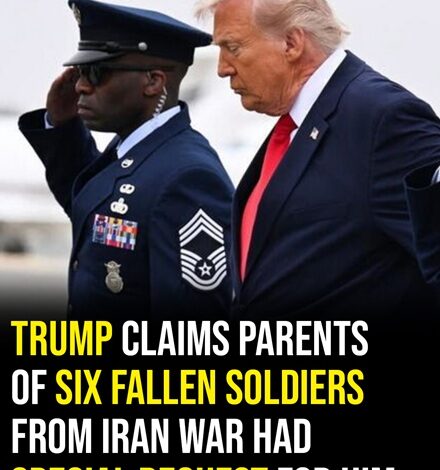
President Donald Trump attended the dignified transfer ceremony at Dover Air Force Base and met privately with the families of the fallen soldiers following the arrival of their remains.
According to reports, the president spoke with the families during the ceremony and later reflected on those conversations while speaking to journalists about the conflict and its human cost.
Trump described the families as courageous and deeply devoted to the memory of their loved ones. He emphasized the sacrifices made by military families and acknowledged the emotional weight of their loss.
While addressing reporters, Trump said that the meeting with the families had been one of the most powerful moments of the week. He explained that every family shared similar feelings about the mission and its purpose.
According to the president, several of the families encouraged him to continue pursuing the objectives of the military operation despite the tragic losses that had occurred.
Trump recalled that many of the parents expressed a common message during their conversations. They urged the government to ensure that the mission carried meaning and that the sacrifices of their loved ones would not be forgotten.
In describing the conversations, Trump said the families had asked him to “finish the job,” a phrase he repeated when discussing the future of the operation with members of the press.
The president also acknowledged that military conflicts often carry unavoidable risks and difficult consequences. However, he emphasized that the United States would continue striving to limit casualties and protect service members whenever possible.
During the same period, the Pentagon confirmed that the number of American personnel killed during the early stages of the conflict had risen to seven.
The seventh casualty was identified as 26-year-old Army Sergeant Benjamin N. Pennington, who died after sustaining injuries during an Iranian attack targeting American forces in Saudi Arabia.
Pennington’s death highlighted the expanding scope of the conflict and underscored the risks faced by American troops stationed across the Middle East during the unfolding crisis.
Military officials noted that many service members involved in the operation were supporting logistical, defensive, or surveillance roles rather than direct combat missions.
Nevertheless, the unpredictable nature of drone warfare and missile attacks has made even support positions vulnerable to sudden strikes.
As the conflict progressed, American and Israeli forces continued conducting targeted air operations against Iranian military infrastructure, including missile launch systems and drone production facilities.
President Trump later stated in interviews that the military campaign had significantly reduced Iran’s ability to conduct coordinated attacks. He suggested that Iranian naval, communication, and air capabilities had been heavily weakened.
Despite these claims, intelligence officials cautioned that Iran’s government and security forces remained intact and capable of continuing operations if necessary.
Analysts noted that while some infrastructure had been damaged, Iran still retained considerable military resources and regional influence.
The ongoing situation has raised questions among policymakers and international observers about the long-term goals of the campaign and whether further escalation could occur.
Some experts believe diplomatic negotiations may eventually become necessary to prevent the conflict from spreading further across the Middle East.
Others argue that continued military pressure may influence Iran’s strategic decisions and encourage new political developments within the country.
Meanwhile, families of the fallen soldiers continue to receive support from military organizations, veteran groups, and communities across the United States.
Public memorial services, tributes, and messages of gratitude have been shared nationwide as Americans honor the service and sacrifice of those who lost their lives.
For many citizens, the stories of the six soldiers killed in Kuwait serve as a reminder of the personal cost behind global military decisions and international conflicts.
Their dedication to duty, military leaders say, represents the commitment of thousands of service members who continue working to maintain security and stability during uncertain times.
As the situation continues to develop, governments around the world are closely monitoring the conflict and evaluating its potential impact on global security.
While some officials suggest the most intense phase of the military campaign may be nearing completion, the region remains on alert for possible additional developments.
For the families of the fallen soldiers, however, the focus remains on remembering the courage and character of those who served.
Their lives and service are now part of the broader story of a conflict that has reshaped international relations and reminded the world of the profound human cost of war.