Jeep plows into Amish buggy near Berne, father airlifted, multiple children!
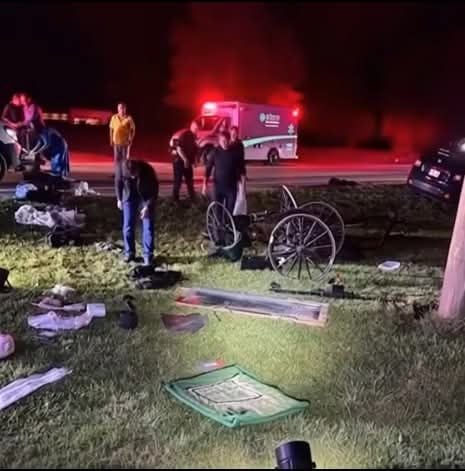
The stillness of the rural landscape near Berne was shattered late at night when a segment of State Road 218 became the site of a violent intersection between two vastly different eras. In a single, catastrophic moment, a Jeep traveling at highway speeds plowed into the rear of a horse-drawn Amish buggy, an impact that served as a brutal reminder of the inherent dangers facing those who navigate modern infrastructure using traditional means. The carriage, constructed of wood and fabric, was carrying nine occupants when it was struck, and the force of the collision was so severe that it effectively disintegrated the vehicle, hurling its passengers across the dark asphalt. The quiet rhythm of a family’s journey home was instantly replaced by the piercing mechanical scream of sirens, the blinding glare of floodlights, and the rhythmic thrum of helicopter rotors descending from the sky.
Of the nine people aboard the buggy, seven sustained injuries, the majority of whom were children. The scene was one of profound chaos and urgent medical intervention. Emergency responders worked under the pressure of the clock and the cover of night to stabilize the victims, several of whom were in critical condition. The father, suffering from life-threatening trauma, had to be airlifted from the scene to a regional trauma center, leaving behind a wreckage that told a story of a way of life suddenly and violently interrupted. As the injured were rushed to various hospitals, the local community was left to grapple with the immediate fallout of a tragedy that felt both shocking and, for many who live in the area, tragically predictable.
Law enforcement and accident reconstruction teams arrived shortly after the collision to begin the meticulous process of piecing together the sequence of events. While the physical evidence at the scene provided a grim roadmap of the impact, investigators turned their attention to the driver of the Jeep. Standard protocol in such high-stakes accidents involves testing the driver’s blood for substances that might impair judgment or reaction time, and those results are currently pending. The central question of the investigation focuses on visibility and speed: did the driver simply fail to see the slower-moving vehicle in time, or were there external factors that contributed to the lack of awareness? On a road where the speed limit is designed for modern steel and internal combustion, a horse-drawn carriage moving at a fraction of that speed creates a dangerous disparity that requires constant vigilance from every motorist.
For the Amish community surrounding Berne, this is far more than a headline or a fleeting news report; it is a visceral realization of their daily vulnerability. The Amish way of life is built on a foundation of simplicity and a deliberate separation from modern technology, yet their reliance on horse-drawn transportation necessitates the use of public roads shared with high-speed vehicles. This creates a perpetual and high-stakes gamble every time a family hitches a horse to a buggy. Despite the use of reflective tape, battery-powered lights, and slow-moving vehicle signs, a wooden carriage offers virtually no structural protection against a multi-ton SUV or truck. When these two worlds collide, the outcome is almost always lopsided, leaving the buggy occupants to bear the brunt of the kinetic energy.
The psychological impact of such an event ripples through the community long after the physical wreckage is cleared. Every curve in the road and every stretch of highway traveled at dusk or after dark is now shadowed by the memory of this specific, violent moment. There is a profound sense of mourning for the injured, but also a collective anxiety about the future. The roads that connect their farms, schools, and places of worship are the same roads that host the high-speed transit of the modern world. This incident highlights a growing tension in rural areas where urban sprawl and increased traffic volume are encroaching on traditional enclaves. As more drivers utilize these backroads as shortcuts or high-speed corridors, the risk to the Amish population increases exponentially.
In the aftermath of the Berne collision, conversations regarding road safety and mutual respect have been reignited. Safety advocates often point to the need for wider shoulders, dedicated buggy lanes, or increased public awareness campaigns to remind motorists that they share the road with non-motorized vehicles. For the Amish, the challenge is maintaining their cultural identity and religious commitments while adapting to a world that moves at an increasingly frantic pace. Some communities have begun adopting more robust lighting systems or even brighter reflective materials, yet these are only partial solutions to a fundamental problem of physics and speed. A horse-drawn vehicle is, by its very nature, a slow-moving object in a fast-moving world, and no amount of reflective tape can compensate for a driver who is distracted, impaired, or simply moving too fast to react to an obstacle in the road.
The search for meaning in such a tragedy often leads back to the resilience of the community. In the days following the accident, neighbors and kin have likely gathered to support the affected family, tending to their farms, preparing meals, and offering the quiet, steady presence that defines their social structure. This internal support system is the bedrock of Amish life, providing a safety net that the modern world often lacks. Yet, as they pray for the recovery of the father and the children, the reality of the road remains unchanged. The morning after the crash, other buggies were back on the same stretch of State Road 218, their drivers holding the reins with a little more tension, their eyes scanning the rearview mirrors with a heightened sense of caution.
Ultimately, the incident outside Berne serves as a somber reflection on the cost of progress and the friction that occurs when disparate cultures occupy the same space. It is a story of a fragile wooden carriage shattered by steel, but it is also a story of a community’s endurance in the face of modernity. As investigators conclude their report and the legal process begins to unfold, the true impact of the crash will be measured in the long months of rehabilitation for the injured and the permanent changes in the lives of those children who survived. The modern world came too fast that night, and it did not see them in time, leaving a scar on the landscape and a community that reminds everyone of the precarious balance between the past and the present.