What This Everyday Hand Gesture Really Meant in the Past!
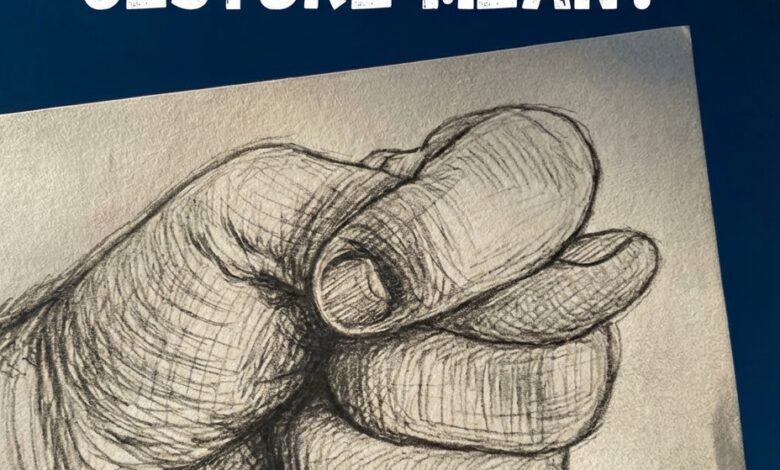
In the vast and intricate tapestry of human communication, where spoken words often fail or carry too much weight, the subtle language of gestures has historically provided a nuanced alternative. We often think of body language in modern terms—the crossed arms of defensiveness or the open palms of honesty—but history is littered with specific, coded signals that once carried the weight of an entire conversation. Among these, few are as curious or as rich in subtext as the “fig” gesture. At a casual glance, it appears to be nothing more than a simple clenched fist. However, the defining characteristic lies in the placement of the thumb, which is tucked tightly and visibly between the index and middle fingers. This small anatomical adjustment transforms a symbol of aggression into something far more complex: a gesture of quiet defiance, symbolic protection, and sharp, non-verbal wit.
Long before the digital era introduced us to the convenience of the “thumbs down” emoji or the shorthand of a text message, the “making of a fig” served as a versatile tool for social navigation. Its origins are deeply rooted in antiquity, but it found its most vibrant expression in the social landscapes of 19th-century Europe. In the tightly knit villages of Italy, France, and the Mediterranean, where social hierarchies were rigid and open confrontation could lead to lasting feuds, the fig gesture offered a vital pressure valve. It was the ultimate “silent no.” To “make a fig” at someone was to deliver a rejection that was at once playful and firm, a way to decline an unfair request or signal that a particular demand was simply “not happening.”
In these historic rural settings, the gesture functioned as a clever mechanism for resistance without the need for open hostility. Imagine a village market or a local gathering where a figure of authority—perhaps a landlord or an overbearing official—made a demand that was perceived as unjust. A verbal argument might result in legal trouble or physical conflict. However, a hand tucked discreetly into a pocket or partially hidden by a sleeve, forming the fig, allowed the individual to maintain their dignity and express their defiance without escalating the situation. It was a manifestation of subtle strength, a way to hold one’s ground while employing a sense of humor as a shield. The closed fist represented the strength of the community or the individual, while the protruding thumb acted as a metaphorical “naught”—the visual representation of getting nothing.
Beyond its role in social defiance, the fig gesture was steeped in the rich tradition of apotropaic magic—the use of symbols to ward off evil. In many cultures, the gesture was believed to be a powerful deterrent against the “evil eye” or general misfortune. This added a layer of protective significance to the motion. When a mother made the gesture as her child walked toward a difficult task, or a traveler tucked their thumb before a long journey, they weren’t just being defiant; they were invoking a traditional form of spiritual armor. It was a silent prayer for safety, a physical manifestation of the hope that bad luck would find no purchase in their presence. This blending of humor, rejection, and protection made the fig a deeply personal and emotionally resonant signal.
As the decades passed, the gesture migrated from the village square into the intimate theater of family life. It became a staple of childhood play and a marker of generational wisdom. Grandparents would pass the gesture down to their grandchildren, often using it in a lighthearted context to respond to a playful tease or to teach the child the importance of standing one’s ground. In these moments, the gesture lost its edge of social protest and became a tool for building resilience. It was a way of saying, “I am listening, but I will not be swayed,” delivered with a wink and a smile. Sometimes, it even carried an unexpected weight of comfort. During times of uncertainty or before long-distance farewells, the gesture could be a silent signal of shared courage—a secret code between loved ones that signaled an unbreakable bond.
The decline of the fig gesture in the modern era is a quiet casualty of our shift toward digital communication. In a world where we express our moods through standardized icons and high-resolution video calls, the need for subtle, hand-crafted signals has diminished. The nuance of the “fig” has been largely replaced by more blunt instruments of communication. We live in an age of loud assertions and immediate reactions, where the art of the subtle refusal is often lost in the noise of constant connectivity. Yet, for those who grew up in households where these traditions persisted, the memory of the gesture remains a powerful reminder of human creativity. It speaks to a time when we communicated with our whole selves, using the movement of a single digit to convey a world of meaning.
The history of the “fig” teaches us that the most meaningful messages are often the ones delivered with the least amount of noise. It reminds us that resilience does not always require a raised voice or an aggressive stance. True strength can be found in the deliberate, witty, and subtle ways we choose to say “no.” It is a testament to the sophistication of our ancestors, who understood that a hidden thumb could be as effective as a thousand-word manifesto. By looking back at these everyday gestures, we gain a deeper appreciation for the layers of meaning that exist beneath the surface of our interactions.
In reflecting on this forgotten language, we find a sense of continuity with the past. Though the “fig” may rarely be seen in the boardrooms or city streets of today, the human impulse it represents is eternal. We still seek ways to protect ourselves from misfortune, to stand our ground against overreaching authority, and to joke with our loved ones in a way that is uniquely our own. The gesture may have faded, but the spirit of resilience and the penchant for wit remain. It is a small, overlooked detail in the grand history of mankind, but it serves as a beautiful example of how we have always found ways to speak our truths, even when we choose not to say a single word.