Military Veterans Surprise Teen Who Carried His Disabled Friend for Miles
The silence in our home has always been heavy, but it hasn’t always been empty. Ever since my husband passed away three years ago, my twelve-year-old son Leo has carried a quiet kind of strength that most adults never manage to find. He doesn’t say much, and he doesn’t complain, but he feels the weight of the world with an intensity that often keeps him on the periphery of the loud, chaotic lives of his peers. That was until the school hiking trip changed everything.
It started with a spark in his eyes I hadn’t seen in years. Leo came home and dropped his backpack, telling me that his best friend Sam wanted to go on the upcoming sixth-grade camping trip, but the school had deemed it impossible. Sam has been in a wheelchair since birth, and the rugged mountain trails were considered a liability. To the school administration, Sam was a logistical problem. To Leo, Sam was a friend being left behind. Leo didn’t argue with the teachers at the time; he simply listened, his mind already churning with a determination I didn’t yet realize was there.
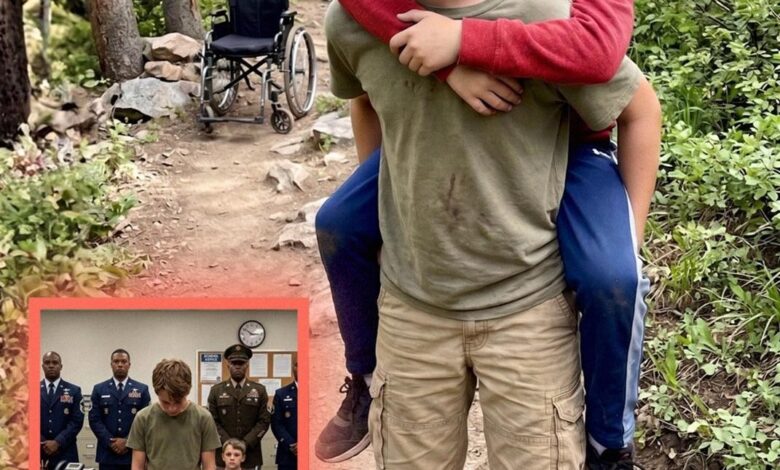
When the buses returned to the school parking lot on Saturday afternoon, I expected to see a tired but happy boy. Instead, I saw a child who looked like he had been through a war. Leo was the last one off the bus. His clothes were caked in dried mud, his shirt was drenched in sweat, and his legs were visibly shaking as he stepped onto the asphalt. His face was pale, his breathing labored, yet he held a look of profound, exhausted peace. Before I could even reach him, a parent named Jill intercepted me. Her eyes were wide with a mix of disbelief and admiration. She told me that while the rest of the class followed the easy paths, Leo had taken Sam. Not just pushed him, but when the terrain turned to loose rock and steep inclines where wheels couldn’t go, Leo had hoisted Sam onto his back.
He had carried his best friend for six grueling miles. Every time Sam begged him to stop, every time the teachers yelled for them to turn back and wait at the campsite, Leo simply tightened his grip and whispered, “I’ve got you. We’re finishing this together.”
The fallout was immediate. Mr. Dunn, the class teacher, approached us in the parking lot with a face reddened by fury. He lectured me about “protocol” and “safety violations,” claiming Leo had put both boys in danger by deviating from the approved path. He spoke of the incident as if it were a mark of shame rather than a miracle of friendship. I apologized for the worry caused, but inside, I felt a soaring sense of pride that almost made me weep.
The next morning, the situation escalated. I received a frantic call from Principal Harris. Her voice was trembling, and she told me I needed to get to the school immediately because “men in uniforms” were there specifically asking for Leo. My heart plummeted. I assumed the school was pressing charges or that some official disciplinary action was being taken by the state. I drove like a woman possessed, my hands white-knuckled on the steering wheel.
When I burst into the principal’s office, I froze. Five men stood in a row, dressed in full military fatigues. They were stone-faced, tall, and intimidating. Leo was already there, huddled in a chair, looking absolutely terrified. He saw me and his eyes flooded with tears. He began to apologize frantically, promising he would never disobey orders again, begging them not to “take him away.” It was a heartbreaking sight—a boy who had done the most noble thing imaginable now believing he was a criminal for it. Mr. Dunn stood in the corner, looking smug, even adding a comment that Leo should have thought about the consequences before playing hero.
Then, the tallest of the soldiers, Lieutenant Carlson, stepped forward. His stern expression didn’t break, but his voice was unexpectedly soft. He knelt down so he was eye-level with my son and told him they weren’t there to punish him. He explained that word of Leo’s actions had reached them through a very specific channel.
The door opened, and Sam’s mother, Sally, walked in. She was crying, but she was smiling through the tears. She explained that Sam’s father, Mark, had been a General who had died in combat years ago. Before his passing, Mark was the only person who could take Sam into the wild, carrying him on his back so the boy could see the world beyond the pavement. Since Mark died, Sam had lived a life of limitations, watching his friends go where he could not follow.
When Sam returned from the hike, he wasn’t just tired; he was transformed. He spoke of the wind at the summit, the smell of the pine needles, and the way the valley looked from the highest peak—sights he thought he would never see in his lifetime. He told his mother that when Leo’s legs were buckling and his skin was bruised from the weight, Leo had refused to set him down, saying, “As long as we are friends, I will never leave you behind.”
The military men weren’t there to arrest Leo; they were there as Mark’s former brothers-in-arms. They had come to stand in the gap for a fallen comrade. Lieutenant Carlson looked at the principal and the scowling Mr. Dunn and made it clear that what they saw as a “protocol violation,” the military saw as the highest form of leadership and sacrifice.
In front of the stunned school staff, the soldiers announced that they had established a full-ride scholarship fund in Leo’s name. Any university, any dream, any future he wanted was now paid for in full. Captain Reynolds then stepped forward and pinned a commemorative unit patch onto Leo’s shoulder—a symbol of brotherhood and bravery usually reserved for those in the field. He told Leo that Sam’s father would have been honored to call him a son.
The atmosphere in the room shifted from one of stifling tension to overwhelming grace. I watched as my son, who had spent three years in the shadow of his own grief, finally stood tall. He wasn’t just the quiet boy in the back of the classroom anymore. He was a young man who understood that the true measure of a person isn’t found in how fast they can run the trail, but in who they are willing to carry when the path gets steep.
As we walked out into the hallway, Sam was waiting in his wheelchair, flanked by the remaining soldiers. The two boys locked eyes and grinned, the kind of secret, unbreakable smile that only exists between people who have survived something difficult together. There was no more talk of rules or danger. There was only the reality of a world that had become just a little bit wider for a boy who thought it was closed to him, and a future that had become infinitely brighter for the boy who was brave enough to carry him there. I realized then that while I had spent years trying to protect Leo from the world, he had been busy learning how to change it.