He Got Stuck in a Hole Barely Bigger Than His Body, What Happened Inside That Space Will Stay With You
You can sense it even if you’re not there.
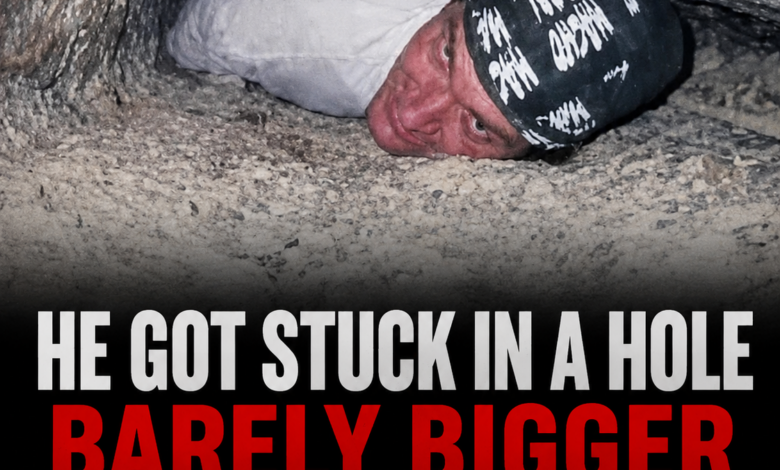
Your breath shortens, your chest tightens, and your mind instantly looks for an escape route that doesn’t exist after just one glance at the situation. A person is crammed so closely between jagged stones that even turning their head appears to be a difficulty, deep within a small fissure in the ground.
There isn’t any room.
Not enough space to move around comfortably.
No obvious way out.
However, there was no terror at the start of this time. Curiosity was the first step.
Because that’s how such things always begin.
Not with peril, but with discovery.
The need to see what’s hidden has a profoundly human quality. There is a certain peaceful mystery to caves, tunnels, and underground passageways. They guarantee exploration, difficulty, and the excitement of entering a realm that few people ever encounter.
It is difficult for explorers to resist its pull.
At first glance, the opening to a narrow passage doesn’t appear to be a trap. It appears to be a path. Yes, it’s a small one, but doable. Something that could open up on the other side and that you could crawl through with caution.
So you enter.
Carefully, slowly, and intently.
Everything seems to be under control at first.
Then something shifts.
The room becomes more constrained.
The angle changes.
Unexpectedly, the rock presses closer.
Suddenly, you find that you are unable to move as you had anticipated.
At that point, everything turns upside down.
In this case, the guy had pushed just far enough into that small opening that it was no longer easy to turn around. Their torso was pinned, their shoulders were crushed, and their legs were stretched out behind them, giving them very little leverage to push backward, all in line with the contour of the rock.
Even breathing started to cause issues.
It’s not just about oxygen in cramped areas like these; it’s also about pressure. The chest is unable to fully extend. Every breath seems constrained and smaller than it ought to be. And the mind responds promptly when the body detects that restriction.
Panic starts at that point.
It’s not an option.
It’s a response.
The pulse rate, respiration, and thinking all quicken when the brain perceives a threat. The natural tendency is to move, push your way out, and resist the space that is closing in on you.
However, that impulse may exacerbate the situation.
since rock is immobile.
Furthermore, pushing your body against something so inflexible usually results in one thing: you get stuck even more.
You can practically sense the tension just by looking at the pose. With just enough room to breathe, the person’s face is turned to the side and forced against uneven stone. Their arms are confined in a way that restricts their range of motion. They are unable to push themselves back out with the force of their outstretched legs behind them.
It is a total loss of autonomy.
And that’s why it’s so intense.
The environment isn’t the biggest concern in such circumstances.
It’s the mind.
People don’t always have claustrophobia until they find themselves in a scenario like this. The walls seem closer than they actually are. It feels like the air is heavier. Unnaturally, time stretches. Thoughts speed up, seconds seem longer, and the body responds as though the room is getting smaller, even when it isn’t.
Control is therefore more important than strength.
Because exerting more effort is not the answer.
It has to do with thinking clearly.
This is understood by seasoned cave explorers. They prepare for it. They are aware that every movement in confined spaces must be intentional. Force is not as important as small tweaks. Techniques that generate space when none seems to exist include angling the body, gently transferring weight, and releasing tension.
Above all, they are aware of when to stop.
When you’re stuck, stillness may seem counterintuitive. Your entire being yearns to move and get away right away. However, pausing is sometimes the safest course of action.
Take slow breaths.
Allow your body to relax.
Instead of raising the pressure, lower it.
That’s how space starts to reappear.
However, preparedness is crucial.
Furthermore, not everyone who walks into these settings is really aware of what they’re getting into.
Underground systems and caverns are unpredictable. What appears to be a reasonable gap can abruptly close. Stable things can change. If visibility is poor or conditions change, even seasoned explorers may misinterpret a passage.
Helmets, illumination, communication, familiarity with the terrain, and having someone know where you are are all important aspects of preparation. These details are not optional. They serve as protections against situations such as these.
The margin for mistake vanishes without them.
You can’t simply glance at the image to answer the questions it poses. Was this individual alone themselves? Were there anyone in the area who could direct them? Did they possess the resources or expertise necessary to handle such a situation?
Because even a slight advantage counts in a situation like this.
And everything gets more difficult without it.
Beyond the threat to one’s physical safety, something more profound is taking on here.
A basic aspect of being human is reflected in this moment.
Discovery, invention, and adventure are all motivated by the same curiosity that propels someone into a cave. It’s what motivates people to push boundaries, discover what’s hidden, and go beyond what is known.
However, being curious without caution puts you at risk.
Furthermore, risk does not pardon errors in situations such as these.
That’s what this particular moment stands for.
the precise intersection of purpose and consequence.
where the choice to explore turns into a survival crisis.
If the individual was able to break out on their own, it was not due to fear or coercion. It would have required endurance. tiny, deliberate motions. Inch by inch, the body is carefully repositioned to relieve pressure rather than resist it.
Perhaps they found just enough room to release the grip by slightly shifting their shoulders. Perhaps they calmed their body enough to think clearly by adjusting their breathing. Perhaps they were guided by someone outside the cleft, providing guidance that they were unable to perceive from within.
It wasn’t simple, though.
It wasn’t fast either.
Such moments create a lasting impression.
It’s awareness, not simply relief.
an awareness of how easily control might vanish. How seemingly manageable conditions might suddenly transform. Respecting environments that don’t adapt to human demands is crucial.
Because there is no negotiation in nature.
It doesn’t adjust to comfort.
It just is.
And humility is necessary to enter it.
This picture depicts more than just a person confined to a small area.
It concerns the boundary that each of us crosses when we venture beyond our comfort zones.
the harmony of prudence and interest.
The distinction between knowing when to stop and continuing.
and the understanding that sometimes pushing harder isn’t the best course of action.
Slowing down is the key.
Inhaling.
and navigating a situation that cannot be coerced by force.
even when it seems like the walls are getting closer.