A 452-Year Sentence for a Teenager Divides a Nation Over Justice and Redemption
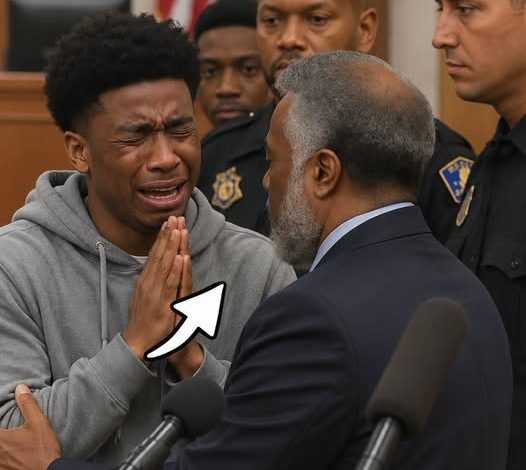
A courtroom gasped, a nation froze, and a single number shattered any illusion of normal justice.
**Four hundred and fifty-two years.**
For a teenager.
The sentence was so vast that it seemed almost impossible to comprehend. It was not measured in months, years, or even the span of an ordinary lifetime. It stretched beyond the natural boundaries of human existence, turning a courtroom punishment into something that felt almost symbolic—a declaration that, for this young defendant, the future had effectively been erased.
For the families of the victims, however, the number carried a different meaning.
They had lived through the kind of loss that changes the shape of every day that follows. They had buried loved ones, dreams, birthdays that would never come, graduations that would never be attended, phone calls that would never be answered. Their grief could not be reduced to a legal statistic. Behind every charge was a person. Behind every count was a family forced to learn how to live with an absence that could never be repaired.
So when the judge delivered a sentence of 452 years, some relatives clung to it as though it were the only language powerful enough to acknowledge what had been taken from them.
They had lost futures.
Now, the court had declared that he would lose his.
For them, the sentence was not necessarily about revenge. It was about recognition. It was about making certain that the magnitude of the crime could not be softened by time, forgotten by headlines, or reduced to a footnote once the cameras disappeared. The impossible number became a kind of wall between their pain and the possibility that the world might eventually move on without remembering what they had endured.
To grieving families, justice is rarely an abstract philosophical question. It is often painfully personal.
It is sitting in a bedroom that belongs to someone who will never return.
It is seeing a photograph and remembering a voice.
It is watching other families celebrate milestones while knowing that one chair at your own table will remain permanently empty.
In that context, a sentence of 452 years could feel like the system finally saying: **We heard you. We understand that something irreversible happened here.**
But beyond the courthouse doors, the number created another, far more uncomfortable debate.
What should society do with someone who commits terrible acts before reaching adulthood?
That question has no easy answer.
Teenagers can make devastating decisions. They can cause unimaginable harm. They can be capable of violence that leaves victims and families carrying consequences for the rest of their lives. Accountability cannot simply disappear because someone is young.
But youth also matters.
A teenager is not psychologically identical to a fully developed adult. Judgment is still forming. Impulse control is still developing. Vulnerability to peer pressure can be profound. And, perhaps most importantly, the capacity for change is still enormous.
That does not erase responsibility.
It complicates it.
And that complication is exactly what made the 452-year sentence so powerful—and so disturbing.
A punishment of that scale does more than determine where someone will spend the rest of his life. It raises a philosophical question about whether a human being should ever be permanently defined by the worst thing he has done.
Because people change.
Some change slowly. Some change after years of consequences. Some never change at all. But the possibility exists, particularly in young people, that the person standing before a judge at sixteen or seventeen may not be the same person decades later.
That possibility is difficult to discuss when the victims are gone.
For families who have suffered unimaginable loss, talk of rehabilitation can sound like an insult. The person who committed the crime may someday grow older, become remorseful, or seek redemption—but the victims will never receive that opportunity. Their lives ended. Their families must carry the consequences forever.
That imbalance is impossible to ignore.
The offender may have a future.
The victims do not.
And yet the justice system is forced to make decisions not only about what happened, but about what comes next.
That is where the case became larger than one teenager, one courtroom, or one extraordinary sentence.
It became a mirror held up to society.
Do we believe justice exists primarily to punish?
Do we believe its purpose is to protect?
Can it provide accountability while still recognizing that young people possess a capacity for transformation?
And if someone has committed something horrific, is redemption still meaningful—or does the nature of the crime permanently close that door?
There are no comfortable answers.
A 452-year sentence cannot restore a single life. It cannot return a child to a grieving parent. It cannot erase the memories of those who witnessed violence. It cannot give families the future they imagined before tragedy entered their lives.
What it can do is establish a boundary.
It can say that certain actions carry consequences so severe that freedom may never be restored.
But the sentence also carries another message, whether intended or not: that the person who committed the crime may be treated as though the possibility of a different future no longer matters.
That is why the case continued to divide people long after the courtroom emptied.
Some saw the sentence as justice finally matching the horror of the crime.
Others saw it as evidence of a system struggling to reconcile punishment with the reality that the defendant was still a child when his choices were made.
Between those positions was a painful truth neither side could escape:
**The victims deserved justice. And the teenager was still young.**
Both things could be true at the same time.
Perhaps that is what made the number 452 so haunting. It sounded precise, but the questions surrounding it were anything but.
A number can measure years.
It cannot measure grief.
It cannot measure remorse.
It cannot measure whether a person can change.
It cannot measure the worth of a life, whether victim or offender.
And it certainly cannot tell us what justice should ultimately look like.
Years later, people may forget the courtroom arguments, the headlines, and even the details of the case. But the larger question will remain.
When someone does something terrible while still young, should justice close the door forever—or should it leave the smallest possible opening for accountability, transformation, and redemption?
Perhaps justice is not about pretending the past never happened.
Perhaps it is about refusing to let the past become the only thing the future is allowed to be.
The victims can never be given their lives back.
Their families can never be asked to simply forget.
But a justice system must decide whether punishment exists only to end a story—or whether, even after the darkest chapter, it is possible to leave a narrow door open for a different ending.
Four hundred and fifty-two years was a sentence measured in numbers.
The question it left behind was measured in something much harder:
**What do we believe a human life is still capable of becoming?**